Girl, Why Are You Looking at Her Butt?: The Unspoken Relationship Between Body Comparison, Shame, and Self-Image

Tuesday Pause™
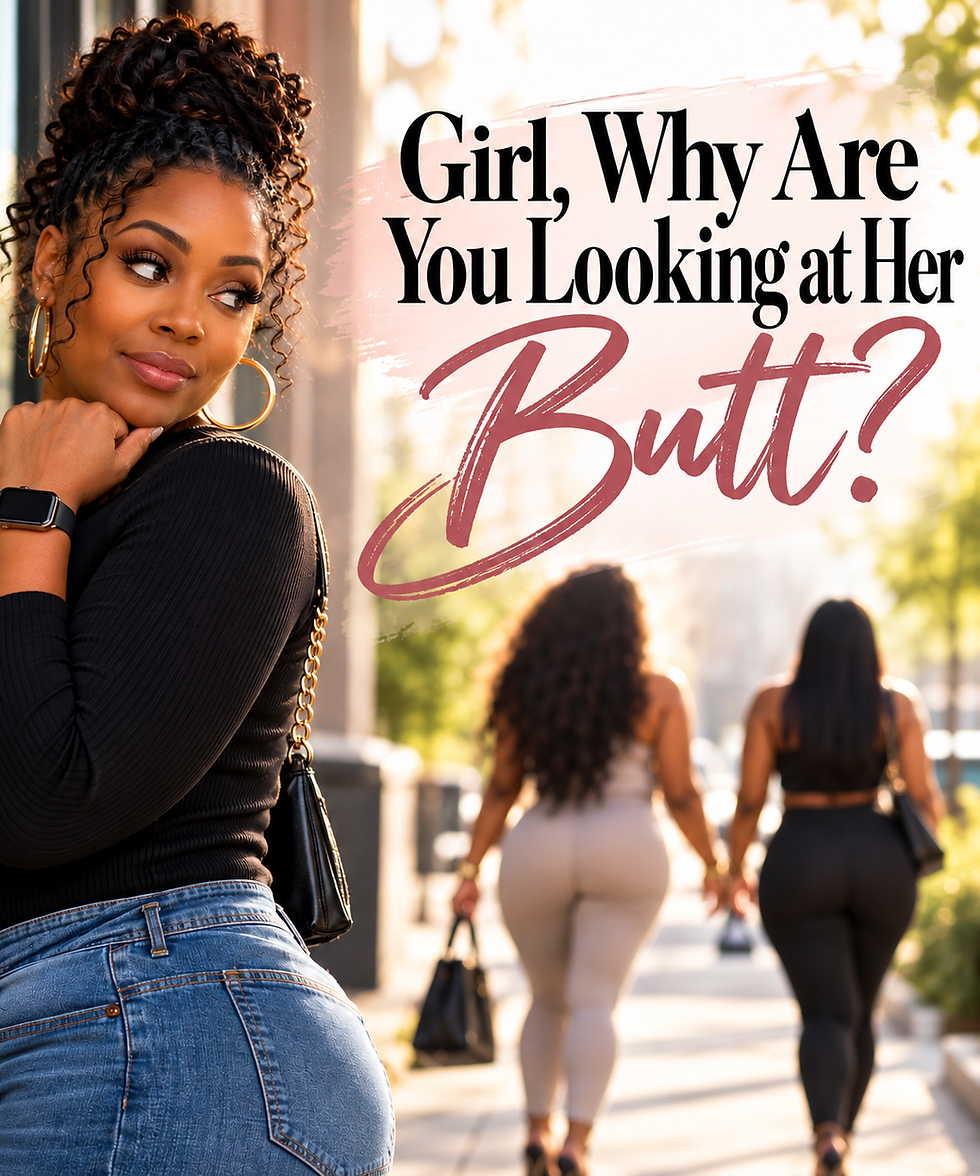
I guess you can say it’s pretty taboo for women to admit that they are guilty of looking at other women’s butts. However, I’ve had tons of conversations where women have opened up to me about having this struggle, and my response is often, “Girl, me too!”
For a very long time, shame plagued me when it came to this, and if I’m honest, sometimes it still does. I’ve had to catch myself when I’d begin to stare. Not obviously, of course. LOL!
You see, my affinity for butt watching dates back many, many years. I can still hear the reminders, whether or not they were innocent, “You have big ole titties, but no behind.”
I’d laugh it off, but truthfully, those words stung. And although I don’t find myself staring nearly as much these days, I’ve come to recognize something about myself that I didn’t fully understand back then... my looking was never sexual in nature. It was comparison. I wasn’t looking at these women because I desired them. I was looking at something I had been made to feel I was lacking.
And I know I’m not the only one.
It makes me wonder how many of us have spent years comparing ourselves to other women because we’ve been conditioned to believe they possess something that makes them more desirable, feminine, or beautiful than we are.
Think about how casually we discuss women’s bodies, particularly within the Black community. “She ain’t got no shape.” “She built like a boy.” “She needs some meat on her bones.” Or my personal favorite, “She got all that up top and nothing down below.”
Sound familiar?
What’s troubling is how normalized these conversations have become, often coming from the very people who love us. And although the comments may have been made jokingly, the impact isn’t always funny. Sometimes people make statements about our bodies, move on with their lives, and never think about them again, while we spend years remembering exactly what they said.
I’ve come to realize that you can genuinely love your body and still struggle with comparing certain parts of it to someone else’s. And that doesn’t automatically mean you have low self-esteem or hate your appearance. Sometimes, it simply means there are things we’ve internalized that we haven’t fully examined.
But when does comparison become something more concerning?
Body dysmorphic disorder (BDD) is a mental health condition involving an excessive preoccupation with perceived flaws in one’s appearance. Now, comparing your body to another woman’s doesn’t automatically mean you have BDD. However, when concerns about your appearance become persistent, distressing, or begin interfering with your daily life, it’s worth paying attention to.
And while we’re discussing body image, I believe we need to talk about eating disorders, too. There’s a misconception that eating disorders primarily affect white women, but Black women experience them as well—I know this because silently, I've struggled. Unfortunately, cultural stereotypes, stigma, and barriers to care can contribute to these struggles going unrecognized.
How many of us have normalized unhealthy relationships with food or exercise because we’re simply trying to look better? How many have felt guilty after eating something we enjoy, so we purge? Or, used exercise as punishment for what we ate?
There’s nothing wrong with wanting to improve your physical health or change your appearance, but I do believe we should examine the motivation behind those desires, because there’s a difference between caring for your body and constantly fighting against it.
Now, this part is personal... As many of you know, I’ve been on a weight loss journey. What many don’t know is that I’ve been pursuing this particular goal for nearly 12 years. And recently, I FINALLY reached my goal weight!
Y’all, I was EXCITED! Not simply because of the number on the scale, but because of everything that number represented. Years of trying, setbacks, weight regain, and moments when I wondered whether I’d ever get there or if I should just settle.
Several years ago, I came within approximately 10 to 15 pounds of where I am today before eventually regaining weight. And during this most recent journey, I found myself stuck at that same familiar number for months. Until finally, those last few pounds started coming off.
But here’s what’s been weighing on my mind... Throughout this journey, I’ve had people repeatedly tell me that I’ve lost enough weight. “You’re getting too small.” “You don’t need to lose any more.” “You need to stop.” And while I recognize that some of these comments may come from genuine concern, I wonder how many of those same people have ever stopped to ask what my goal was or why it mattered to me? Have they considered what it means to finally accomplish something I’ve been pursuing for nearly 12 years? Or have they simply decided that because my body has reached a size, they’re comfortable with, I should be comfortable stopping?
Here’s what many people don’t know. I’m only 5’2”, and even after reaching my goal, my weight still falls within the overweight category according to traditional BMI measurements. I also battle high blood pressure. My mother died at 54 years old, and her mother, as well as two of her sisters, had breast cancer. One of those sisters, her mother, and another sister didn’t live beyond 70 years old. ANDDDD, diabetes runs rampant. And that’s just on my mother’s side of the family.
On my father’s side, this year alone has been filled with a number of deaths. I’m not even familiar with their health histories, but I can tell you that not many of those deaths were due to old age.
So, while some may assume this journey has primarily been about my appearance, my health has played a significant role. Some of us just want to be healthy.
And here’s something else I’ve noticed. People seem to have so much to say when you’re losing weight, but when you’re gaining, the response is often very different. Sometimes there’s silence. Sometimes there are those up-and-down glances that communicate more than words ever could. But how often do we stop to consider what someone may be experiencing? Are they grieving? Battling depression? Navigating a medical condition? Dealing with something emotionally that has affected their physical health? We don’t always know. Yet somehow, we feel comfortable offering opinions about what someone else’s body should look like. I've been guilty!
I recognize that weight loss can become unhealthy and that genuine concerns deserve compassionate conversations. Still, there’s a difference between expressing concern and repeatedly telling someone what to do with their body based on your personal preferences.
For me, reaching my goal wasn’t about proving anything to anybody. It was about fulfilling a commitment I’d made to myself—it was about me loving myself OUT LOUD. While others may see a smaller body, I see perseverance, discipline, and a woman who kept going despite the setbacks. My body is not a community project, and neither is yours.
As I reflect on all of this, I realize how often we allow other people’s opinions to influence the way we see ourselves. Whether it’s comparing our curves to another woman’s, criticizing our appearance in the mirror, or allowing someone else to determine when we’ve changed enough, the underlying issue is often the same... We’ve given other people’s perspectives more influence over our bodies than they deserve. And social media certainly hasn’t made that any easier. We’re constantly exposed to carefully positioned, edited, or enhanced images that can make us question features we may have never thought twice about. As a mother of daughters, I also wonder what we’re teaching the next generation when we constantly criticize our bodies or comment on someone else’s.
So, here’s what I want you to consider this week...
When was the first time someone made you feel uncomfortable about your body? Do you remember what they said? And have you unknowingly carried those words into adulthood?
Perhaps you’ve spent years comparing yourself to other women (or men). Maybe you’ve worked toward a personal health goal only to have someone tell you when they thought you should stop. Or perhaps you’ve become so accustomed to criticizing your body that you’ve forgotten how much it’s carried you through.
What if the problem was never your body, but the standard you were taught to measure it against?
As for me, I may still catch myself looking at another woman’s behind every now and then. LOL! But I’m learning to recognize the difference between admiring what someone else has and questioning what I have. I’m also learning that my personal health goals don’t have to be understood or approved by everyone else to be meaningful to me, because sometimes, the issue isn’t that we don’t like our bodies. Sometimes, it’s that we remember what it felt like when someone else didn’t. And perhaps healing begins when we stop allowing those memories and opinions to determine how we see ourselves today.
Call to Action
I want to leave you with two questions to consider: When I look at another woman, am I admiring what she has, or am I questioning what I have? And when I comment on another woman’s body, is it coming from a place of genuine concern, or am I simply expressing my personal preference?
Because here's the truth: Another woman’s beauty doesn’t diminish yours, and her body is not an invitation for your opinion.
With love,
Jante



Comments